
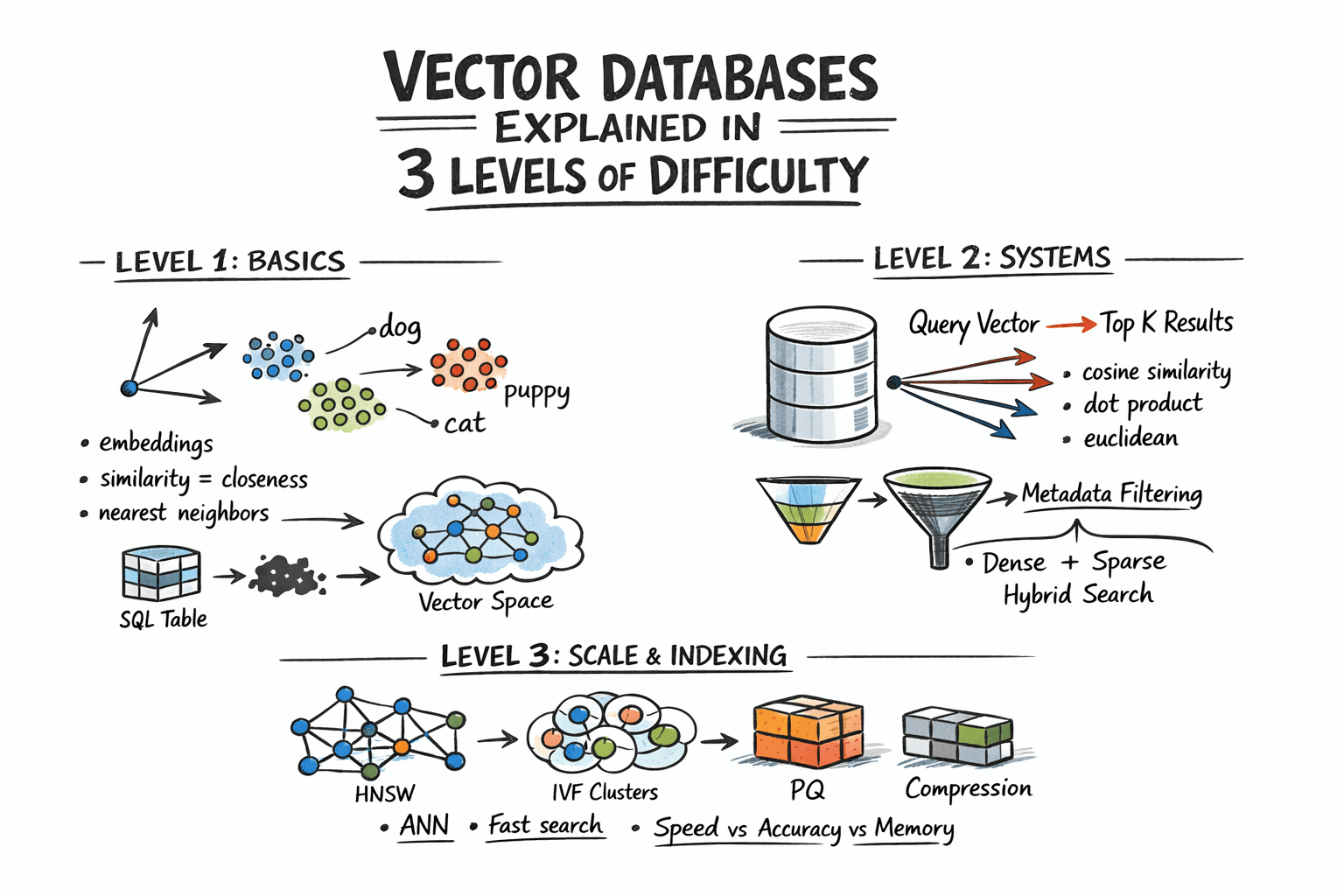
Vector Databases Explained in 3 Levels of Difficulty
Vector databases are now ubiquitous in AI pipelines, powering similarity search, retrieval-augmented generation, and large-scale embeddings. This three-level explainer breaks down the concept for different audiences—from beginners to advanced practitioners—covering core ideas such as indexing, similarity metrics, and the trade-offs between precision, recall, and latency. The piece also touches on integration with ML tooling ecosystems and how vector stores fit into modern MLOps.
For engineers, the article offers a concise framework for selecting a vector database based on workload characteristics, data scale, and latency requirements. It also highlights operational considerations such as freshness of embeddings, update strategies, and storage costs. For architects and product leaders, the guide emphasizes the strategic importance of having robust retrieval systems that can support downstream tasks like document analysis, question answering, and knowledge management across enterprise environments. The bottom line is that vector databases are no longer a niche technology but a central component of contemporary AI infrastructure.
As AI systems grow, the ability to efficiently store and retrieve high-dimensional representations becomes a competitive differentiator. This piece is a valuable primer for teams looking to optimize their AI data pipelines and ensure that their embedding-based workflows scale gracefully as data and user demands expand.
Keywords: vector databases, retrieval, embeddings, AI infrastructure